
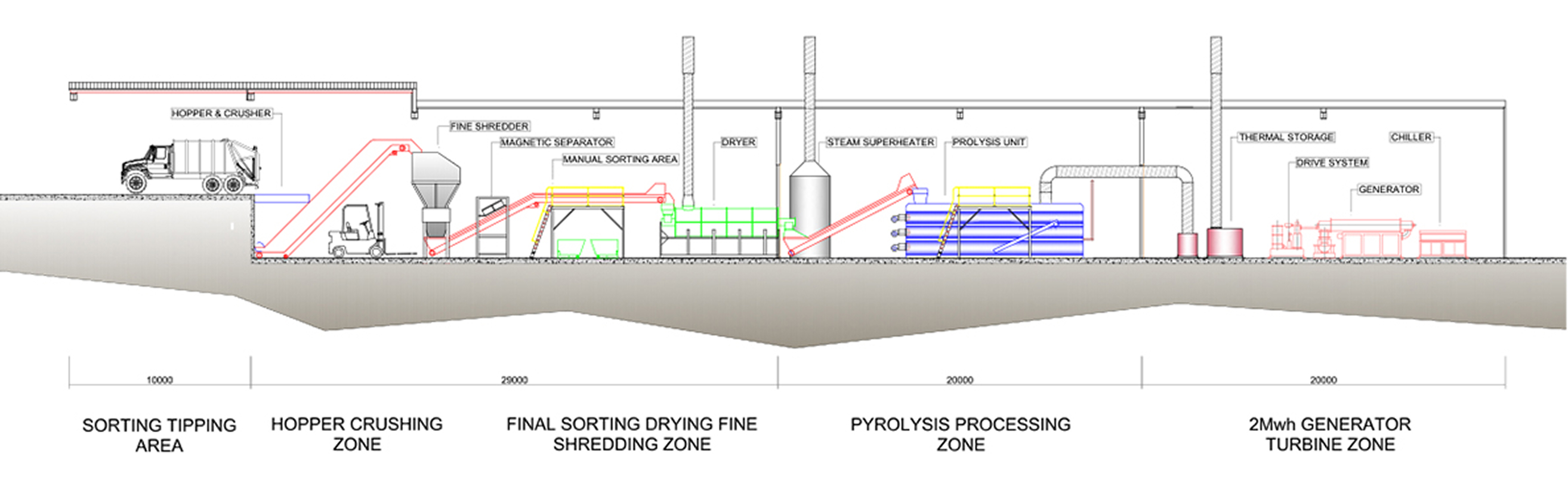
Pyrolysis consists of an endothermic reaction. General combustion occurs through the generation of heat in the pyrolysis chamber producing solids and liquids. The feedstock is heated at moderately high temperatures in a low oxygen atmosphere. The main parameters that govern the pyrolysis process are the waste characteristics (calorific value, carbon content, density and particle size), temperature, heating rate, solid residence time and volatile residence time.
The residual products produced in the pyrolysis process vary depending on the feedstock type. Cellulose material and some biomass produce biochar and activated carbon, whilst Mixed Residual Waste (MRW) and Municipal Solid Waste (MSW) produce a small amount of inert ash (typically 10% of weight). The syngas produced is used to self-maintain the pyrolysis combustion process,generate electricity via turbines and to produce pyrolysis oil, which is refined to diesel. GGII also have a number of new and innovative technologies that can be applied to Bioplant’s license in the future.

Global Green Energy Group isn’t just solving waste problems—we are pioneering the future of energy with fast, scalable, profitable, and environmentally responsible solutions. Our modular pyrolysis technology is the most efficient, cost-effective, and sustainable alternative to traditional waste management. GGEG for innovation, efficiency, and a cleaner future.